
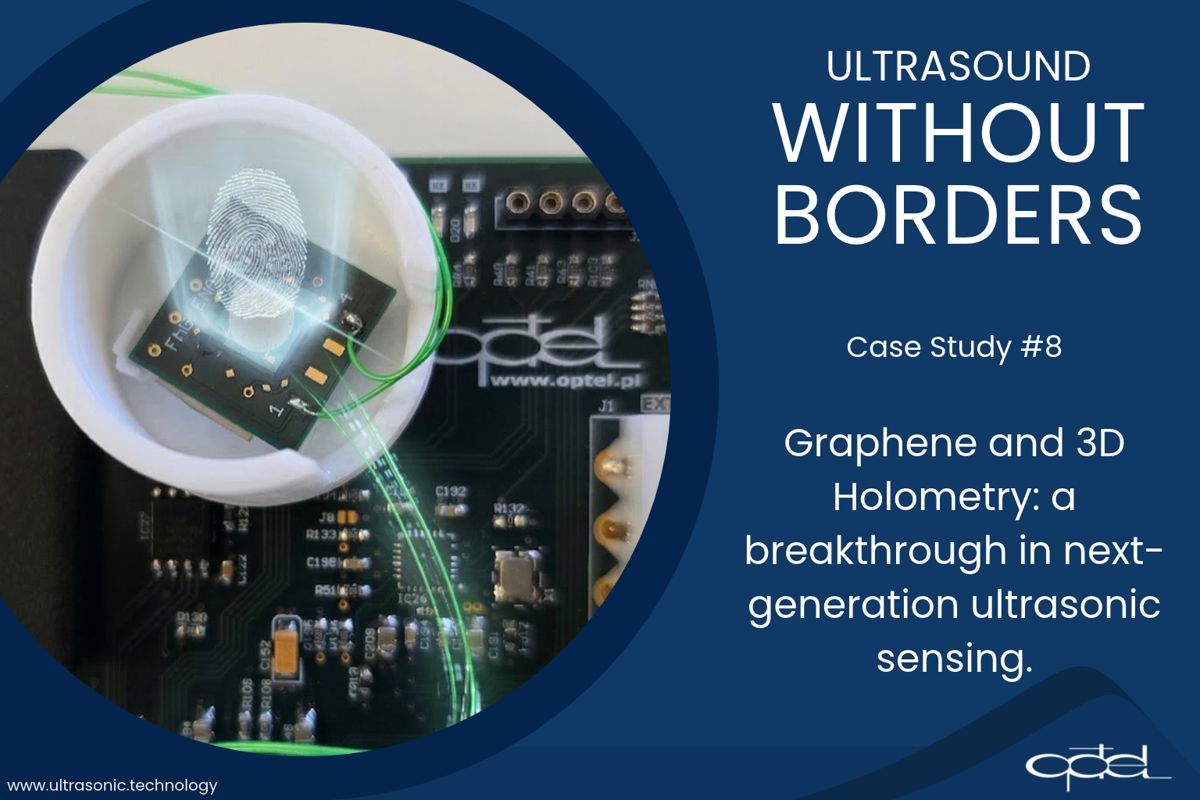
A one-atom-thick membrane – graphene and acoustic holography for 3D imaging in air
For decades contactless ultrasonic imaging in air has faced a fundamental physical barrier: the huge acoustic impedance mismatch between piezoceramics and air. In the international GraSonics project (M-ERA.NET 3) we showed that MEMS transducers with a graphene membrane (G-CMUT) are a way through it.
Challenge
Above 100 kHz classic transducers lose most of their energy by reflection at the solid–air boundary. To drive air efficiently at high frequencies, the transducer membrane must have an extremely low areal mass while remaining mechanically strong.
OPTEL solution
- G-CMUT transducers: monolayer graphene suspended over silicon MEMS micro-cavities gives excellent acoustic matching to air.
- Low-noise acquisition electronics: OPTEL designed dedicated battery-powered bias (HV) electronics and multichannel receivers based on the opLabBox / opCard 2.2 platform.
- 640-channel 3D holographic camera: a matrix system for recording the acoustic field with real-time 3D reconstruction algorithms, plus a laser interferometry verification bench.
Results
- TRL 4 reached: prototypes fully validated in the laboratory.
- A new R&D platform: contactless 3D scanning, gesture detection and inspection of materials sensitive to liquid contact.
Key parameters
- Programme: M-ERA.NET 3, 2022–2025
- Partners: J. Heyrovsky Institute (CZ), Fraunhofer ENAS (DE), OPTEL (PL)
- Camera: 640 channels, real-time 3D reconstruction
- Technology readiness: TRL 4
Related pages
Looking for a technology partner for R&D in MEMS transducers, measurement electronics and acoustic field reconstruction? Let's work together.
Need a solution for a specific measurement problem?
OPTEL can evaluate the measurement physics, transducers, electronics and software before a full system is built.
Start with a feasibility studyContact OPTEL